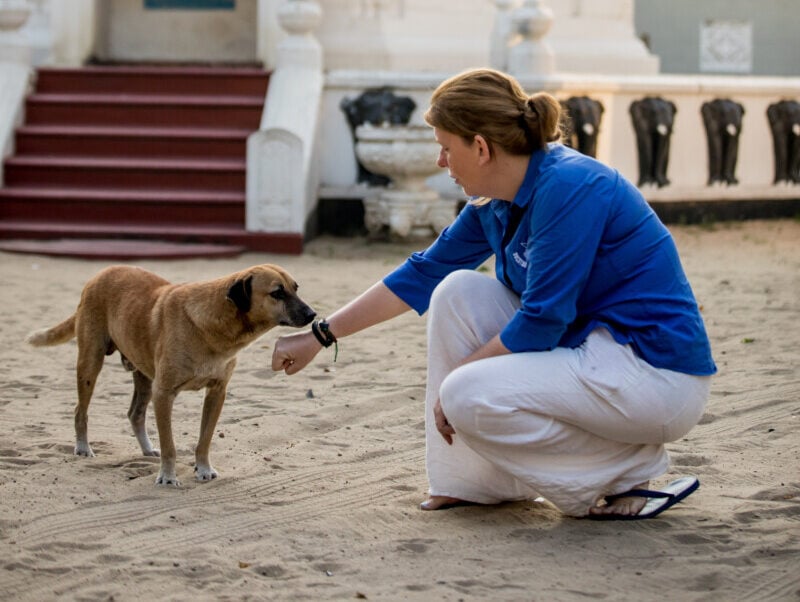
Sam is crouching down extending her right arm towards a dog and letting them sniff her.

It was never about me: Dogstar at 20.

Dogstar is turning 20 and, as I sit at my kitchen table in Donegal writing this, it seems like a good moment to be honest about what the last two decades has taught me.

This is probably not your typical anniversary post. It’s not a celebration (although we have much to celebrate) or a rallying cry. It’s a chance to rewrite the story.

But first, we need to start at the beginning.

One word that changed everything

On 28 September 2006, I said “yes” to a monk and a dog in a temple courtyard, and my life changed course.

The story of that day has been told properly elsewhere, but the short version is that Wangessa Terro asked for help with a sick dog; I named her Mango, and the next morning I woke up with Dogstar fully formed in my head. He is gone now, and so is she, buried under a mango tree at the temple. I think of them both often, especially on the 28th.

I also think of the people whose story sits alongside ours. Dogstar exists because of what happened in London on 7th July 2005, and I never want our anniversary to pass without acknowledging the 52 people who were killed, the hundreds who were injured, and the families and colleagues who still carry that day with them. Our beginning is tangled up with their loss. I hold that carefully.


Not that kind of story

Here is the thing about origin stories. Tell them often enough, and they start to sound like a certain kind of story: a white British woman, a temple, a suffering dog, a life transformed. I know how that reads. I have never really been comfortable with it, and the older Dogstar gets, the less true it is anyway.

Mango was the first patient, but she, like me, was only the catalyst for what came next: life-changing care for more than a hundred thousand cats and dogs. And, of course, the Sri Lankan vets, vet assistants, drivers, catchers, feeders and coordinators who are delivering that care, going above and beyond in the name of animal welfare. When you consider the impact Dogstar has had on so many lives, do not look at me. Look at them.


Table four on a Tuesday afternoon

I could list the things I am proud of, and some of them are the obvious ones: the thousands of sterilisations and vaccinations, our innovative solar-powered mobile spay/neuter trucks, launching our feeding programme during a worldwide pandemic, as well as Catstar, the first feline-only spay/neuter clinic.

Our website can tell you the number of animals whose lives have been changed. But the real story lies with the people and the impact behind those numbers. And what I am actually proudest of is our culture.

Dogstar runs on trust. Our teams are largely self-managing. Clinical decisions are made by the vets doing the surgery, not by someone 5,000 miles away. Standard Operating Procedures (SOPs) are written by experts who do the role. Field decisions are made by the team on the ground because they can see clearly what the animal needs. And, when the clinic is behind, or there’s an emergency at table four on a Tuesday afternoon, the team in Sri Lanka is leading the way.

Two Dogstar vets operating on a cat.

5,000 miles away

Since 2022 I have made a deliberate effort to step back and let good people be good at their jobs. That, more than any single number, is the thing I would like to be remembered for as a founder.

And, since March 2026 I have been living in Donegal, caring for my mother. I still lead Dogstar, remotely, and I still travel to Sri Lanka. I’m still excited for Dogstar’s plans for the future. 

But, if an organisation can only function when the founder is standing in the clinic, it is not really an organisation. Dogstar has kept going, kept growing and maintained its exceptional standards. I am deeply proud of the team, but it’s also given me a chance to reflect.


The Dogstar way

In the television series Ted Lasso, journalist Trent Crimm gives Ted the manuscript for his book, titled The Lasso Way. Ted sends it back with a note: “One small suggestion. I’d change the title. It’s not about me. It never was.” The book becomes The Richmond Way. I have thought about that scene a lot this year.

I feel the same. It is not the Sam way. It is the Dogstar way, and the Dogstar way lives on board a solar-powered surgery truck, in a dedicated cat clinic and on a feeding round at dawn. It is in the hands, hearts and minds of our brilliant Sri Lankan team. 

Twenty years ago, I was very lucky to be in the courtyard that day. Meeting Mango and her monk might have started something. But our team has made it soar. 

And, before I forget, thank you: for believing in Dogstar and for being part of our journey. 

Here’s to the next 20.

Sam